Osteoporosis Prevention Women 40+: Bone Density & Strength Guide
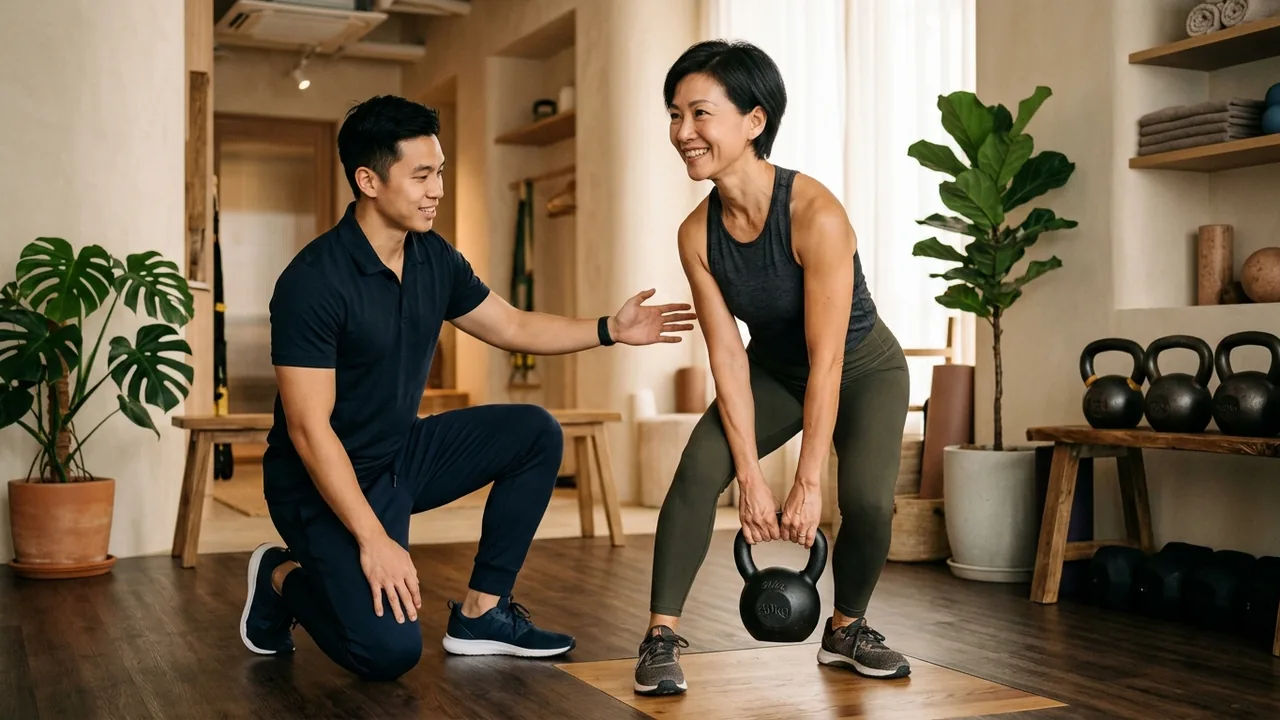
Prioritizing osteoporosis prevention women over 40 in Singapore requires recognizing that bone mineral density (BMD) declines rapidly during perimenopause due to dropping estrogen. Hip and vertebral fragility fractures among women over 50 cause severe mobility loss and independence decline. While walking, swimming, and pilates offer general health benefits, they lack the axial skeletal loading needed for osteogenesis. Rebuilding cortical bone density requires targeted progressive resistance training guided by exercise physiology.
Clinically proven osteoporosis prevention women over 40 in Singapore require progressive resistance training that delivers mechanical strain exceeding the minimum essential strain (MES) threshold to trigger bone remodeling. Under Wolff's Law and landmark trials like LIFTMOR, multi-joint compound movements—such as trap bar deadlifts, goblet squats, and overhead farmer carries loaded at 75% to 85% of one-repetition maximum (1RM)—stimulate osteoblastic mineral deposition in the lumbar spine and femoral neck. Guided by Coach Sharm (MSc Exercise Science) at our private Sultan Plaza #03-10 studio, women rebuild bone microarchitecture, improve balance, and safely reverse osteopenia without joint injury.
Key Executive Insights:
- ✔Wolff's Law Mechanical Loading: Bones remodel strictly along lines of applied physical force; mechanical strain must reach 1,500 to 3,000 microstrain to stimulate osteoblasts.
- ✔The LIFTMOR Trial Benchmark: Landmark clinical trials show heavy 80–85% 1RM resistance produces +2.9% lumbar bone gains versus continuous loss in light exercise cohorts.
- ✔Sultana Plaza #03-10 Private Coaching: Supervised joint-sparing progressions (trap bar hinges, goblet squats, loaded carries) tailored specifically for women over 45.
- ✔Accessible Starter Pathways: Women's and Menopause strength trial available for $28; private 1-on-1 coaching packages at $98–$158 per session (5-pack at $790).
The Cellular Biology of Bone Remodeling and Menopausal Estrogen Decline
Bone is dynamic, living endocrine tissue undergoing continuous remodeling via two cellular lineages: osteoclasts, which resorb fatigued micro-damaged matrix, and osteoblasts, which synthesize new collagen and mineralize it with calcium-phosphate crystals to build dense bone.
During reproductive years, estrogen preserves skeletal homeostasis. Estrogen suppresses the receptor activator of nuclear factor-kappa B ligand (RANKL), thereby restraining excessive osteoclast proliferation and limiting bone resorption. However, during perimenopause and menopause—typically occurring between ages 45 and 55 among Singapore women—ovarian estrogen synthesis drops precipitously. This hormonal withdrawal removes the biological brake on osteoclastic activity, creating an uncoupled remodeling state where bone resorption massively outpaces osteoblastic bone formation.
According to National University Hospital and HealthHub Singapore osteoporosis guidance, osteoporotic hip fracture incidence in Singapore is among the highest in Asia. Women can lose up to 10% to 20% of their total bone mineral density within the first five to seven years post-menopause. Trabecular bone—the spongy, lattice-like internal architecture found within the femoral neck, calcaneus, and L1-L4 lumbar vertebral bodies—deteriorates rapidly, leaving the skeleton vulnerable to low-trauma fragility fractures resulting from simple slips or falls. Specialized physical conditioning via a dedicated menopause personal trainer in Singapore provides the necessary hormonal-sparing resistance training to arrest this structural deterioration.
Wolff's Law & The Mechanostat: Why Brisk Walking and Swimming Fail
A common misconception among women over 40 in Singapore is that daily walking or lap swimming safeguards bone density. Biologically, this guidance is incomplete. In 1892, Julius Wolff established Wolff's Law: bone tissue adapts its internal architecture and cortical density directly in response to the mechanical forces placed upon it.
In modern orthopedic science, Dr. Harold Frost advanced this principle through the 'Mechanostat Theory'. Bone contains osteocytes—mechanosensory dendritic cells embedded within the mineralized lacunae. When a skeletal bone is subjected to significant mechanical loading, microscopic bending occurs, generating fluid shear stress within the canalicular network. This fluid shear triggers osteocytes to down-regulate sclerostin (an inhibitor of bone formation) and up-regulate prostaglandin E2 and Wnt/beta-catenin signaling, commanding osteoblasts to deposit new bone.
Bone remodeling requires mechanical strain exceeding the Minimum Essential Strain (MES) threshold of 1,500 to 3,000 microstrain. Buoyant swimming produces zero osteogenic adaptation in the hip or spine, while walking generates forces of only 1.0x to 1.2x bodyweight—insufficient to deform the femoral neck cortex. Progressive resistance training at 75% to 85% 1RM is essential.
The LIFTMOR Landmark Trial: Evidence for Heavy Multi-Joint Loading
Historically, practitioners hesitated to prescribe heavy resistance training to women with low bone density. That hesitation was overturned by the landmark LIFTMOR randomized controlled trial published by Watson et al. in the Journal of Bone and Mineral Research (LIFTMOR PubMed clinical trial).
The LIFTMOR researchers recruited postmenopausal women with low to very low bone mineral density (T-scores below -1.0) and assigned them to either eight months of twice-weekly, high-intensity resistance training (5 sets of 5 repetitions at 80% to 85% 1RM of deadlifts, squats, and overhead presses, plus jumping chin-ups with drop landings) or a low-intensity home exercise control program. The results were revolutionary:
- •Lumbar Spine BMD: The high-intensity lifting group gained +2.9% bone mineral density in the lumbar spine (L1-L4), while the control group lost -1.2%.
- •Femoral Neck BMD: The lifting group increased femoral neck bone density by +0.3% and cortical thickness by +13.6%, versus continuous bone thinning in controls.
- •Zero Fractures: Across more than 2,600 training sessions under certified supervision, there were zero vertebral or peripheral fractures and zero adverse events.
The scientific consensus championed by the American College of Sports Medicine (ACSM) is unequivocal: heavy, multi-joint resistance training is not merely safe for women over 40—it is the single most potent non-pharmacological stimulus for reversing bone loss.
Quantitative Comparison: Exercise Modalities for Bone Mineral Density
The following clinical comparison matrix contrasts common physical activities practiced by women over 40 in Singapore, evaluating their mechanical ground reaction forces, osteogenic stimulus, and structural bone remodeling impact:
| Exercise Modality | Axial / Ground Force | Osteogenic Stimulus (1-10) | Femoral & Spine BMD Effect | Fall Prevention & Muscle Mass |
|---|---|---|---|---|
| Swimming & Water Aerobics | < 0.2x Bodyweight (Buoyant) | 1 / 10 (Negligible) | Zero osteogenic signal; BMD continues age-related decline | Minimal balance adaptation or fast-twitch recruitment |
| Brisk Walking & 10,000 Steps | 1.0x – 1.2x Bodyweight | 3 / 10 (Insufficient) | Maintains baseline calcaneal bone; fails to rebuild spine or hip | Good cardiovascular maintenance; lacks trip-recovery strength |
| Mat Pilates & Gentle Yoga | 1.0x Bodyweight (Isometric) | 4 / 10 (Moderate core) | Improves posture; lacks dynamic bone bending strain | Good flexibility; cautioned against loaded spinal flexion |
| Light 1-2 kg Dumbbell Classes | 1.1x – 1.3x Bodyweight | 4 / 10 (Sub-threshold) | Builds muscular endurance; fails to reach Minimum Essential Strain | Moderate endurance; does not reverse sarcopenic muscle loss |
| Heavy Multi-Joint Resistance (75-85% 1RM) | 2.5x – 3.5x Axial Load | 10 / 10 (Clinical Gold Standard) | +2.9% Lumbar spine gain; reverses cortical bone thinning | Maximizes fast-twitch type II fibers & reactive trip recovery |
Safe Biomechanical Progressions for Women 40+ at Sultan Plaza #03-10
Executing heavy resistance training safely requires meticulous biomechanical calibration, particularly for women who are deconditioned, returning from an exercise hiatus, or diagnosed with osteopenia. At BodyThrive's private boutique studio at Sultan Plaza #03-10 (100 Jalan Sultan), Coach Sharm utilizes a clinical movement continuum that eliminates shear stress on vulnerable spinal discs while maximizing axial osteogenic compression:
-
►
The Neutral-Spine Hip Hinge (Trap Bar Deadlift): Rather than conventional straight-bar deadlifts that pull the barbell away from the body and create excessive shear force on the L4-L5 lumbar junction, we utilize hexagonal trap bars with elevated handles. The neutral grip allows the lifter to position the center of mass inside the weight, distributing force evenly through the hips, hamstrings, and gluteus maximus while applying safe axial compression through the femoral neck.
-
►
Axial Squat Variations (Goblet to Barbell Box Squat): Clients begin with heavy goblet squats held tightly against the sternum, which reflexively activates the anterior core and prevents spinal rounding. As hip mobility and pelvic stability develop, we progress to barbell box squats. The box enforces consistent depth, eliminates bottom-range knee shearing, and teaches the client to sit back into the posterior chain with perfect control.
-
►
Loaded Carries (Farmer Walks & Suitcase Carries): Walking with heavy dumbbells or kettlebells in hand generates massive lateral hip stabilization demands. The gluteus medius must contract intensely to keep the pelvis level, transmitting powerful compressive forces through the femoral head and neck while training grip strength and spinal endurance.
Women can objectively test their lower-body functional strength and balance using our interactive tools, such as the 30-second chair stand tracker and the single-leg balance tracker, both of which serve as validated clinical indicators of fall vulnerability.
"Bone is dynamic living tissue that obeys Wolff's Law: it remodels along the lines of mechanical stress placed upon it. Walking and light 1-kilogram pink dumbbells do not provide sufficient ground reaction force to deform the bone matrix and signal osteoblasts. If we want to safeguard the femoral neck and lumbar spine in women after 45, we must introduce heavy, controlled axial loading—deadlifts, squats, and overhead carries—with flawless biomechanical execution."
Coaching Pathways at BodyThrive: Rebuild Your Bone Density in Singapore
Every woman's bone density profile, joint history, and hormonal journey is unique. At BodyThrive, we provide specialized coaching programs tailored specifically for mature females seeking to protect their vitality and independence:
- •Women's Strength & Menopause Trial ($28): A comprehensive 60-minute diagnostic session at Sultan Plaza #03-10 including posture assessment, DEXA scan review, and hands-on movement screening.
- •1-on-1 Clinical Strength Coaching: Private, undivided coaching with Coach Sharm designed around your specific orthopedic needs, priced at $98 to $158 per session (Foundational 5-Session Starter Package at $790).
- •Semi-Private Women's Squads: Small, supportive 4-person groups focusing on progressive bone loading and pelvic floor health.
Learn more about our dedicated programs on our fitness for women over 45 Singapore pillar page, explore our specialized female personal trainer Singapore coaching options, or review our comprehensive guide on personal training in Singapore. To understand the economics of quality personal training, read our detailed analysis on the real cost of personal training in Singapore, study our masterclass on progressive overload for beginners, and explore why private studios accelerate results over crowded gyms.
Specialized progressive bone loading and menopause fitness coaching with Coach Sharm (MSc Exercise Science) at our private Sultan Plaza #03-10 studio:
- 1-on-1 Personal Training: Private studio coaching at Sultan Plaza #03-10, packages at $98–$158 per session (Starter 5-Pack at $790).
- Small Group & Corporate Squads: Semi-private high-engagement functional strength sessions, $28 trial.
- East Coast Park Outdoor Fitness: Saturday morning functional conditioning, $7 trial.
Frequently Asked Questions
Can strength training really reverse osteoporosis and osteopenia in women over 40?
Yes. Landmark clinical trials like the LIFTMOR study demonstrated that supervised high-intensity progressive resistance training (80% to 85% 1RM) increases bone mineral density in the lumbar spine (+2.9%) and femoral neck (+0.3%) while significantly enhancing cortical bone thickness, actively reversing osteopenic bone loss.
Is it safe for a woman with low bone density to lift heavy weights?
When performed under expert biomechanical supervision, heavy resistance training is exceptionally safe. At BodyThrive, Coach Sharm (MSc Exercise Science) teaches joint-sparing progressions such as elevated trap bar deadlifts and goblet box squats that avoid spinal flexion while applying safe axial compressive force to stimulate bone growth.
Why are brisk walking, swimming, and light dumbbells insufficient for bone health?
Under Frost's Mechanostat Theory, bone remodeling requires mechanical deformation exceeding the Minimum Essential Strain (MES) threshold (1,500 to 3,000 microstrain). Swimming occurs in buoyant zero-gravity conditions, and walking produces only 1.0x to 1.2x body weight ground impact—insufficient to deform bone cortex and stimulate osteoblasts.
What is included in the BodyThrive Women Over 40 Strength Coaching trial?
Our $28 introductory session includes a 60-minute comprehensive clinical assessment: posture and movement screening, pelvic-lumbar rhythm evaluation, interpretation of existing DEXA scan reports, and a hands-on introduction to safe progressive lifting at our private Sultan Plaza #03-10 studio near Bugis.